


“I’m Glad to See You”
July 2026
Being Open to Every Connection
“This evening, / My wife comes back to me— / Gazing up at the Ullambana moon” (Sumio Mori, Tenjitsu [The sun], Asahi Shimbunsha, 2001). This haiku expresses the sentiment of how sadly beautiful the moon is on the first night of the Ullambana Festival, when a man welcomes home [the spirit of] his deceased wife. The poet also seems to be telling his better half, who has predeceased him, “You would be proud of how I am living, so please don’t worry about me.”
Even if we are not bound to each other by such a profound bond as that of a married couple, none of us can live in utter solitude. True to the meaning of the Japanese word for “human being,” ningen, we exist “between people”—that is, we live our lives amid other people, weaving the fabric of our existence through an accumulation of encounters with people and things. As Founder Niwano so aptly put it, “our lives consist of encounters.”
However, some of our encounters may be painful, leaving us harboring resentment or hatred toward another person. In more mundane cases, we may have quite a few encounters with people we do not get along with, since everyone has different life experiences and values. At such times, we are apt to think to ourselves, “I can’t get along with someone like that” and distance ourselves from them, but for some reason, I have often found myself thinking instead that “this could be an interesting person who possesses qualities I do not,” or simply accepting that other people have their own way of seeing things.
There is a saying that “even brushing sleeves with a passerby is due to a bond from past lives,” and there is also a Buddhist teaching, “the people you talk to or sit with have gone through five hundred lifetimes together with you.” Given that even a chance encounter on the street is believed to be rooted in a deep karmic connection from the past, it would be a shame to deem an encounter good or bad based solely on what suits you or your mood at the time.
The poet Shuntaro Tanikawa (1931–2024) once said, “Thanks to my encounters with other people, I have been able to encounter myself” (Ministry of Education, Culture, Sports, Science and Technology, Kyoiku iinkai geppo [Board of Education monthly report], March 2025, https://www.mext.go.jp/content/20250310-mxt_syoto01-000040534_6.pdf.pdf).
Encounters with people can reveal facets of our own character that we are unaware of, and getting to know the views of those who disagree with our opinions may serve as a whetstone that sharpens our own perspective. It is often said that knowing an equal number of people who agree with you and disagree with you is vital for the refinement of your personality and improving your humanity, and in this sense, I believe that being open to every connection and receptive toward other people makes our lives richer.
Reencountering Those Who Have Passed Away
That said, it is certainly difficult to gladly accept disagreeable situations or people we dislike. Fortunately for us, though, thanks to the Buddha, we can face such people and situations somewhat gladly. In Rissho Kosei-kai, when we are facing people or situations that we find disagreeable, we take the opportunity to reflect on what the Buddha might be teaching us through the experience and calmly consider why we perceive something as distasteful, asking ourselves what is really important right now. This habitual practice of aligning our thinking with the Buddha’s leads to an open and receptive mind.
When we think very deeply, we particularly see that our encounters with others arise from a mysterious convergence of a variety of ongoing causes and conditions. In a standard dictionary, the Japanese word en, “connection” or “karmic connection,” is defined as “a mysterious force, transcending human agency, that binds people together,” so we can only conclude that whoever we have encountered, we were supposed to encounter them. With this in mind, I hope we can all sincerely say, “I’m glad to see you”—not only to our spouses, parents, children, brothers, and sisters but to everyone we encounter—because I believe that interacting with one another amicably, with smiling faces, is a way of life that agrees with the principle of dependent origination, which teaches us that all things are interconnected.
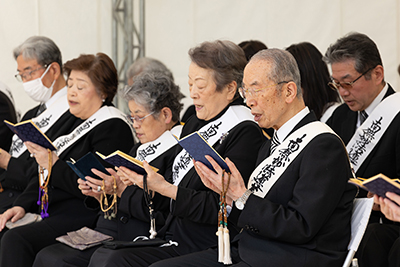
The Ullambana Festival will soon be upon us, and we will again encounter the spirits of our ancestors and family members who have passed away. Reflecting on the old days, we will surely deepen our feelings of nostalgia and gratitude as we tell them, “I’m glad to see you.” At the same time, as we contemplate our gratitude for the life that each of us is currently living, passages from Kyoten recitation—such as Taking Refuge in the Three Treasures and the Universal Transfer of Merit—will resonate within us more deeply than ever, renewing our resolve to live in a way that honors the memory of the departed.